What is this guide?
A living technical map for Brazilian Jiu-Jitsu practitioners. Unlike traditional technique lists, this guide presents BJJ as an interconnected system where every position, transition, and concept relates to the whole.
Choose Your Path
First Day?
Start with the Beginner's Journey — your complete 6-month roadmap Read Four Combat Fundamentals for simplified basics Check the Glossary when you encounter unfamiliar terms
White Belt (0-6 months)?
Follow the Beginner's Journey week-by-week checklist Track your skills with the Skill Progression Map Focus on Fundamentals and the Guard System
Blue Belt & Beyond?
Use the Skill Progression Map to identify gaps Explore Body Reading for deeper understanding Study Competition Strategy and Training Methods
Track Your Training
BJJ Atlas isn't just a reference — it's your personal training companion. The built-in Training Journal lets you:
- Log every session — Track duration, techniques drilled, and session type (Gi, No-Gi, Open Mat)
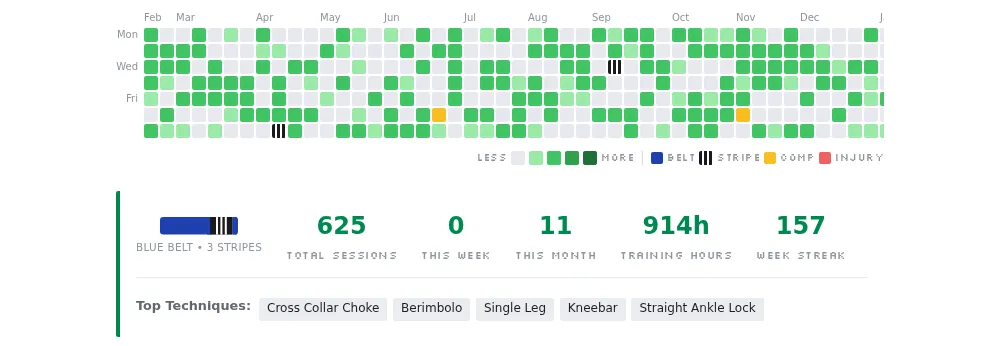
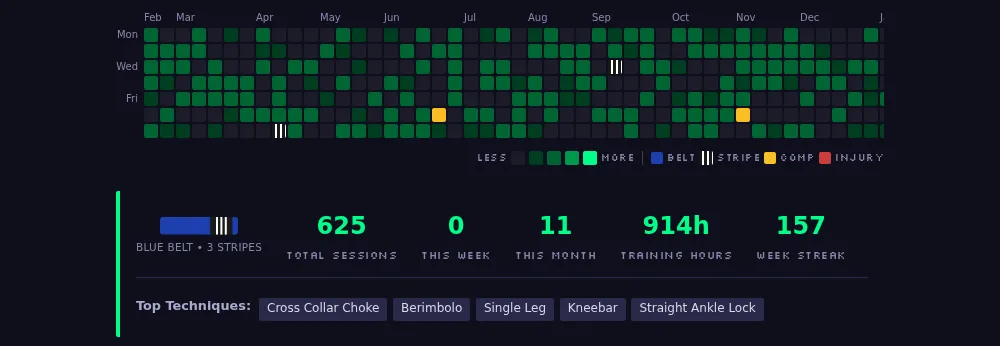
- Visualize your year — GitHub-style heatmap shows your training consistency at a glance
- Record milestones — Belt promotions, stripes, competitions, and injuries on a visual timeline
- Monitor progress — See total sessions, training hours, week streaks, and top techniques
- Share your journey — Generate shareable training cards
All data stays in your browser — no account needed. Start tracking →
The Four Stations
BJJ is a system of interconnected stations. Each position flows naturally into others:
- Standing — Where every fight begins
- Guard — The defensive fortress and attacking platform
- Immobilizations — Dominant control positions
- Submissions — The ultimate goal
Guide Structure
- Fundamentals — Core concepts and the combat map
- Guard System — Complete bottom position strategy
- Immobilizations — Dominant positions and control
- Submissions — Finishing techniques from all positions
- Concepts — Theories and training methodologies
Ready to begin? Start with the Map of Combat